Plan an outward trip, a refill, and a return without relying on invented oxygen timings.
Treat a refill as a supply stop
The current gameplay walkthrough describes oxygen machines that need ice. Returning to the train and locating other oxygen stations are useful, but a station still needs its supply. Check that oxygen is actually recovering before leaving again.
That changes how to plan a trip. Your destination is only half the route; identify the place where the trip ends as well. A station you have merely seen in the distance is less dependable than one you have approached and used.
Restore the nearby public station
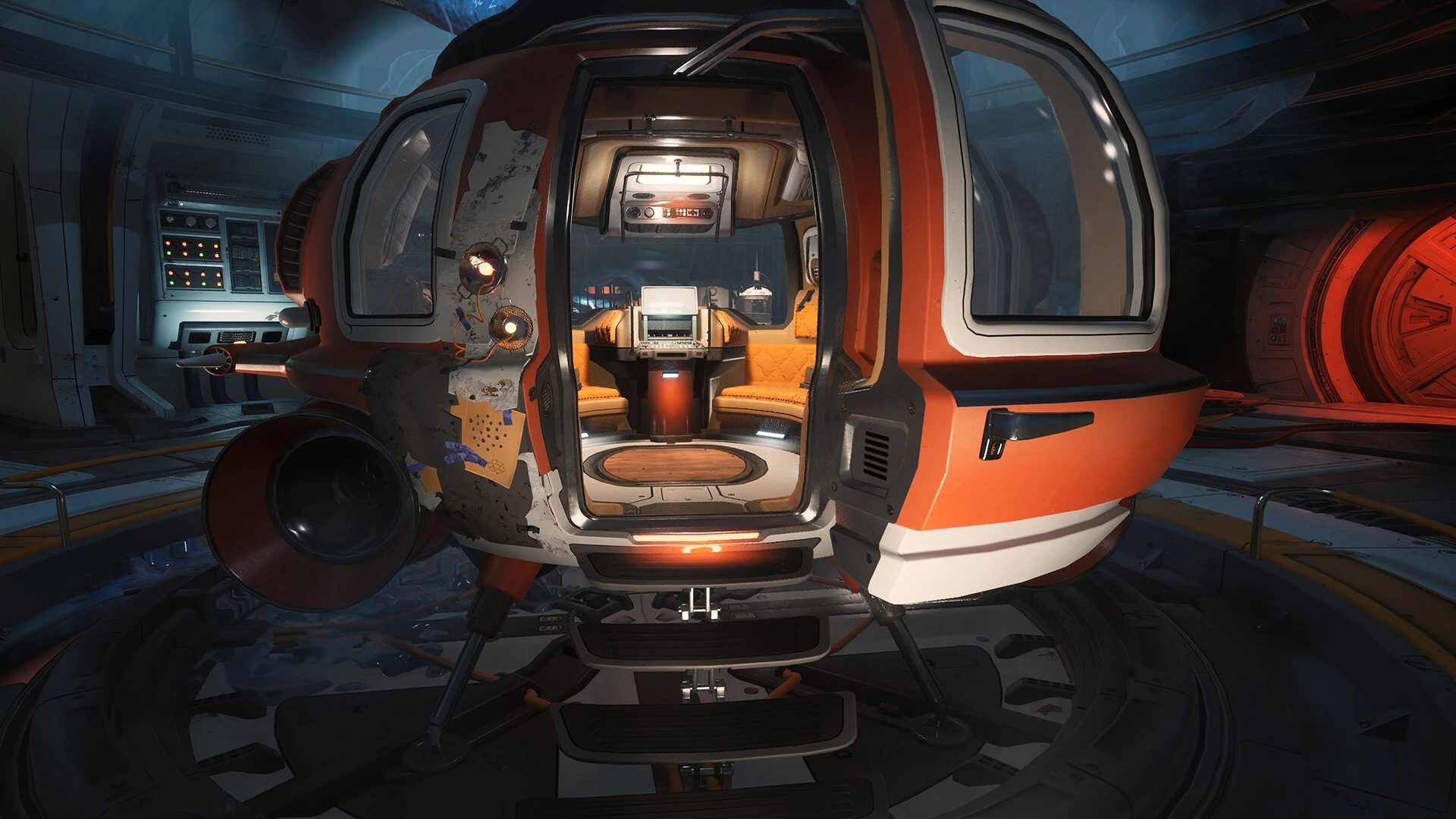
The public oxygen station is left of the train platform, opposite the Attendant area. Neoseeker lists its repair as 3 Metal, 2 Electronics, 1 Wire, and 3 Electrical Tape. Bring ice too, then approach the repaired station to refill.
Use the live repair prompt to confirm those costs before committing materials. Early Access recipes can change. Once the station works, remember its relationship to the train and the nearby structures so you can recognize it from another angle.
Use a turnaround rule you can observe
Do a short outward trip and note your remaining reserve when you return. Use that observed cost to judge the next trip. A route with searching, object handling, or an unfamiliar doorway needs more margin than flying directly between two known points.
Do not convert the oxygen number into an exact travel distance from a guide. Your equipment, route, and current conditions matter. If you cannot confidently point back toward a working refill, end the search early and re-establish your route.
Separate exploration from hauling
When a task involves finding an object and bringing it back, locate it first while keeping the return path in mind. Before committing to the carry, decide where you will stop if the trip takes longer than expected.
If you repeatedly run short in the same place, change the plan rather than repeating the same departure. Shorten the search area, restore a closer refill where available, or resolve the equipment requirement shown by the game. This guide does not claim a universal tank duration or an unlimited oxygen location.
Unlock a carried refill and read its actual cost
Neoseeker records Purified Oxygen unlocking after your first Oxyworm pickup. One craft uses 2 Oxyworms, 1 Metal, and 1 Ice. It lists Oxygen Candles separately: their blueprint follows drawing air from a nest, and the recipe uses an Oxyworm, Battery Cell, and Refined Metal.
These are different recipes with different unlock events. If one does not appear in your menu, compare what you have actually discovered with its stated unlock condition. Having all the ingredients is not necessarily the same as having learned the recipe.
The launch oxygen reference from GameTruth reports 120 Oxygen restored by Purified Oxygen and 600 starting capacity. Treat those as launch values and inspect your own item description and suit display before using them for calculations. Equipment or future balance changes can make a memorized total misleading.
Calculate the reserve without assuming a universal timer
Here is an illustrative calculation, not a measured route: suppose your suit can hold 600, it currently shows 480, and you carry one item that restores 120. You have 600 usable units across that outing, assuming you consume the item without wasting any restoration. You do not have 720 simply because the suit maximum is 600.
Likewise, a refill item does not necessarily extend the suit maximum. If you use a 120-point refill with only a small gap below maximum, part of its potential value may not fit. Read the item behavior in the current build and avoid spending a carried refill beside a machine you can already use.
For a known route, compare the reserve on arrival with the cost you observed traveling there. The return can be shorter if the outward journey included searching, or longer if you lose orientation or must handle an object. Keep additional room for that uncertainty instead of treating a symmetrical route as guaranteed.
Choose the right kind of refill for the job
GameTruth identifies Oxyworm Nests as another source of air alongside machines and carried supplies. A nest can help break a route into shorter legs, but only after you have actually located it and confirmed the interaction. A guide mentioning nests somewhere in a region does not establish a usable stop on your own route.
Fixed refills are most useful when you expect to revisit the area. A carried refill is useful when you cannot yet predict how long the search at the destination will take. Before departing, decide which uncertainty you are paying for: finding the entrance, finishing a repair, locating a small object, or making the return.
If you are searching for something near a refill, use that point as the center of several short searches. Change height or direction between attempts so you cover new space. Spending the entire reserve circling the same visual approach makes the next attempt no better informed.
Separate breathing upgrades from other resources
The launch oxygen reference distinguishes Gas from Oxygen. Read the statistic an upgrade changes before crafting it for longer exploration. A useful equipment name is not sufficient evidence that it increases breathing capacity.
Neoseeker also records practical oxygen rewards from achievements: inspecting ten corpses awards additional maximum Oxygen, while collecting 300 Oxyworms contributes a separate maximum-Oxygen reward. These are player-reported progression options; check the in-game achievement condition before deliberately pursuing one.
Do not postpone a necessary station repair while trying to grind a distant reward. Compare the effort with the route problem you currently have. A nearby reliable refill and a modest carried reserve may solve that problem sooner than a long collection target.
Diagnose a refill that appears not to work
Check your own meter before and after interacting. If it was already full, no visible gain is expected. If it is below maximum, inspect the source itself: is it repaired, supplied, and the object you intended to use?
For a carried item, verify which meter its description restores. For a station, check the supply rather than assuming that a lit model means the refill is ready. For a nest, confirm you are using the nest interaction rather than grabbing a nearby worm. These checks establish what failed without inventing a recovery recipe.
When reporting a persistent failure, include the source type, your Oxygen before the attempt, the prompt, and the result. A refill problem and a rapid-consumption problem can feel similar during a panic, but those observations distinguish them.
Build a reserve calculation from observations, not a stopwatch claim
You can estimate whether to continue without knowing a universal drain rate. Record your Oxygen when leaving a refill and again when reaching a recognizable point. The difference is what that particular outward leg cost under those conditions. It includes whatever you actually did on the way, so it is more useful for your present run than a timer recorded by another player.
Consider a hypothetical outing that begins at 600 and reaches the outside of a wreck at 420. That leg used 180. If the return takes a comparable amount, reserving only 180 would leave no allowance for confusion, another interaction, or a less direct route. Choosing an additional margin is a planning decision. It is not a guarantee that 180 will cover the return or that every player should use the same margin.
Now suppose you spend time searching and the display reaches 270. You should compare that number with the return requirement you reserved, rather than with the original tank maximum. If your chosen return budget is already close to 270, the search has reached its stopping point. The useful number is the reserve after the planned work, not the percentage that looked reassuring at departure.
Understand what a carried refill changes in the calculation
A carried refill adds a limited amount of supply; it does not erase the return requirement. Using the same hypothetical wreck, imagine a refill restores 120 according to your current item description. That additional reserve might cover a short remaining search, but only if enough remains afterward for the trip to a working source. Decide what task that reserve will buy before consuming it.
Avoid counting one item twice. It cannot serve simultaneously as the supply for continuing deeper and the emergency reserve you intend to keep untouched. If you decide to spend it, update the plan immediately. You now have a larger present reserve and one fewer future recovery option.
Also distinguish what is carried from what could be crafted. Ingredients are not automatically a ready refill. Unless you have confirmed that the intended crafting interaction is available under your current conditions, plan around the item you actually have. Preparing before departure removes that uncertainty and leaves your attention on navigation and the objective.
Compare a direct return with a detour to another source
A newly discovered refill can be tempting when the destination looks closer than home. Compare the whole detour: reaching it, identifying its interaction, supplying or repairing it if necessary, and leaving again. The distance to an unfamiliar object measures only the first part of that work.
In an illustrative choice, a known return route might cost about 150 based on an earlier trip, while a possible nearby station is expected to take 90 to reach. The apparent saving is 60, but that advantage disappears if discovering how to use the station takes more than the difference. This is why a confirmed source and an untested source should not receive the same confidence in your plan.
When reserves are comfortable, inspect the new source and make it part of a future route. When reserves are already tight, a familiar return may be the more defensible choice. The guide cannot choose a direction from your screenshot or promise that an unseen source works. What it can do is make the uncertainty part of the decision instead of pretending that every map marker represents immediately usable air.
Account for the work at the destination
Two trips to the same landmark can have very different costs. One might be a direct pickup; another might involve finding a narrow opening, maneuvering a large object, or reading several interactions. Do not let a successful quick visit convince you that every later task there fits the same reserve.
Before entering, name the work you still need to perform. If you cannot yet name it, treat the visit as reconnaissance. Look for the entrance and the requirement, then return with a clearer plan. If you know the task but not its duration, leave more room than you would for a straightforward pickup.
A useful distinction is reversible progress. Learning a location or discovering a requirement can make a later trip easier even if you leave before completing the quest. Continuing until your reserves force a panic can erase that advantage by making the last part of the route difficult to remember. A planned return preserves both supplies and information.
Review a near miss without repeating it
After a close return, reconstruct the moment the plan became unrealistic. Did you stay to inspect an optional prop, misread the next refill, consume your reserve early, or forget the time needed to carry something out? Choose the one change that addresses that moment.
If navigation was the problem, practice the route while there is no search task attached. If the objective took longer than expected, separate finding the target from working on it. If the refill assumption was wrong, inspect that source on a fresh, well-prepared outing before depending on it again. These changes answer different causes; bringing more of everything without identifying the cause may hide the problem for only one trip.
Keep the successful comparison afterward. A note such as reached the entrance with this reserve and returned directly gives you a useful baseline. It remains an observation from a specific setup, not a permanent safe-range rule. Reassess after equipment, difficulty, or game updates alter the conditions you were using.
Use consistent observations when you compare two routes
If you want to compare routes, start both attempts from a similar reserve and keep the intended task the same. A direct flight on one attempt and a long search on the other do not isolate the route. Note any unusual delay instead of attributing every difference to distance.
You do not need perfect experimental conditions to learn something useful. Even a simple record of starting reserve, arrival reserve, and work completed can show that one approach repeatedly leaves you more comfortable. Keep the conclusion local to that route and setup.
Once the comparison answers your question, use the better route and stop measuring. The purpose of the numbers is to reduce uncertainty during play, not to make every outing an accounting exercise.
Sources & verification
This article combines cited facts with practical editorial advice. Follow the version and uncertainty notes before applying an older route.